Robotic process automation (RPA) has gained traction in recent years as organisations embrace digital transformation and automate manual tasks.
In this blog, we discuss RPA and how it can work alongside business process management (BPM) in an organisation’s IT strategy.
What does RPA stand for?
RPA is a form of clerical process automation technology based on the notion of software robots or artificial intelligence (AI) workers (source: Wikipedia). These software ‘robots’ have been trained to perform human tasks by imitating our behaviour to undertake high-volume, manual tasks involving structured data such as data entry.
The ‘robots’ follow documented procedures to replicate human behaviour (i.e. login to a system, copy/paste data, locate data sources etc.). Defined in a script or flowchart and triggered by an event or schedule, these processes are rules-based (i.e. no human decision or interaction required) and highly customisable.
RPA can be used to automate a wide range of business processes, from data entry to customer service.
On the other hand, workflow is the automation of a manual task or business process in which information is passed between systems and/or people and tasks are performed based on a set of procedural business rules.
How is RPA different to BPM?
If you need to quickly automate specific tasks within existing software systems, RPA is a worthy candidate. However, if you are looking to automate the underlying business processes, low-code BPM software such as Process Director is your best option.
While you could use RPA to automate manual processes, it is worth considering an overhaul of your workflow (the ‘progression of steps in a process’). BPM is perfect for situations when you need to refine the overall process to increase efficiency and profitability, not the task.
Automating processes across the organisation is not always possible due to limited budgets, time and/or a lack of stakeholder buy-in. In such scenarios, automating a surface-level task with RPA may offer a quick win. In the meantime, you can investigate BPM and secure stakeholder buy-in for organisation-wide adoption of a more efficient workflow that may use better technology or processes to make the task completely obsolete.
In summary, RPA is focused on tasks, BPM is focussed on processes.
Are RPA and BPM complimentary?
We do not believe RPA solutions will replace BPM. In our opinion, RPA complements BPM and, in many cases, if BPM has been deployed correctly there should be no need for RPA.
One of the barriers to adoption with BPM is working with internal legacy systems. Many companies are reluctant to replace or redesign existing systems due to the complexity and risk associated with the project.
Consequently, outdated software systems that do not include Application Programming Interfaces (APIs) because they were originally developed for a specific purpose are commonplace. An API allows two software applications to integrate and talk to each other, so without them, it can be hard to fit an existing legacy system into a modern, integrated workflow.
RPA offers the intriguing prospect of bypassing the need for an API as it accesses computer systems through the user interface (UI) as a human would. It does not need to contact back-end databases or APIs; instead, developers can create scripts that automate repetitive data entry tasks via the UI.
When to use RPA vs BPM?
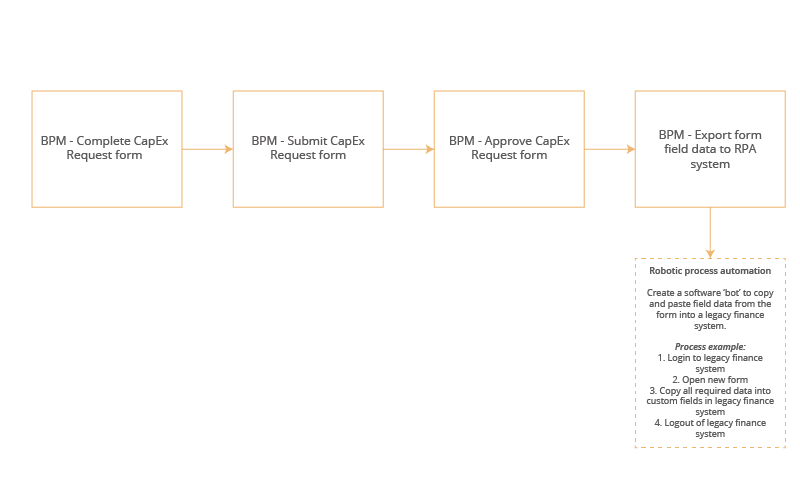
In our fictional scenario below (see figure 1), we have created a capital expenditure approval process (the sequence has been shortened for illustrative purposes). We have automated the process using BPM software but we now need to export the data from the approved CapEx request form to a legacy finance package. This is where we can implement RPA and integrate it with BPM.