Question (QP) and answer (AP) paper design
A structured exam sheet will be designed for each component and optimised for higher capture rates. These form templates may contain bespoke scripting to perform lookups and enforce validation rules.
Key features include:

Answer sheets can be personalised with candidate name, number, session date, component version and other details, including a tracking barcode. This candidate data can be merged with the answer paper direct to print or PDF for electronic distribution and local printing.

Sometimes it is not practical to personalise papers, so instead blank papers can be used with the candidate details read from the papers once they have been scanned. A verification and reconciliation process provides peace of mind they are correctly linked to the right candidate, with any duplicate, missing or erroneous papers highlighted for review.
Non-personalised papers can also be used for late entries or where personalised papers have been damaged or lost.

The templates offer multiple layout possibilities with intelligent character recognition (ICR) reading short written responses and optical character recognition (OCR) capturing machine-printed text and optical mark recognition (OMR) marking answers to multiple-choice questions (MCQ).
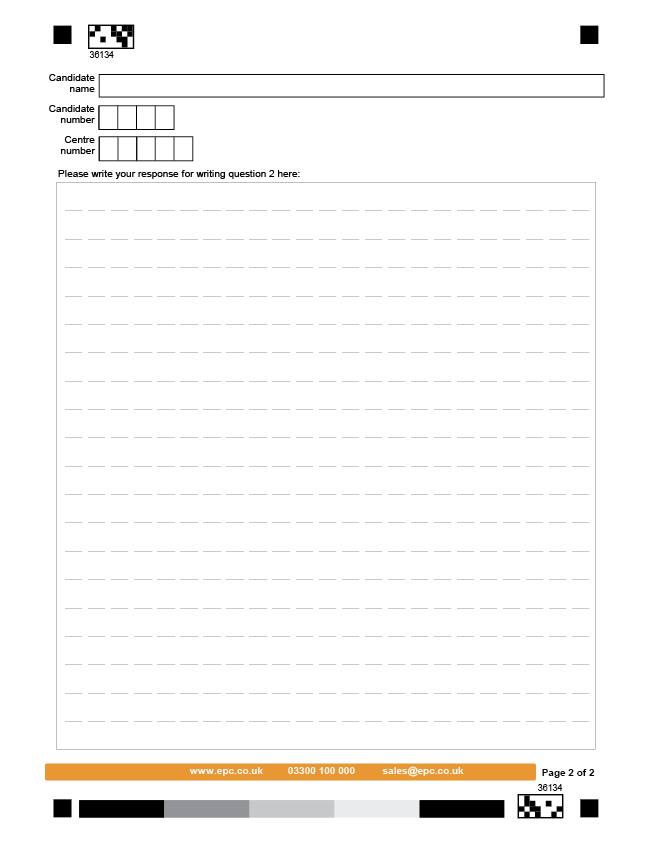
You can design areas for long whiten responses, diagram responses, and even graph paper sections for charts and the like.
Additionally, the answer paper can include cornerstones and ID blocks to reduce manual intervention and barcodes to identify answer paper types and candidates.
To improve test integrity by reducing student collusion, the system allows you to use randomised questions (from a larger set of pre-approved questions for a topic) for your tests.
Exam paper delivery
Once finalised, we will despatch exam scripts.
First, we can securely deliver exam papers by courier to your school/college/university.
Alternatively, we will make them available online via a web portal (grouped by component and/or candidate) ready for downloading and printing by exam venues. Upon receipt, exam papers can be printed professionally, if the volume requires it, or simply on office printers for smaller volumes.
A well designed answer sheet improves the processing of the scanned image and reduces manual intervention and increases capture rates.

Cornerstones
Cornerstones will assist with page alignment, de-skewing images and adjusting for print or scan size variations.
Barcodes
Barcodes can be used to identify candidates and reconcile answer sheets to enrolments.
Cornerstones
Cornerstones will assist with page alignment, de-skewing images and adjusting for print or scan size variations.
Constrained print fields
Handwriting is most effectively read by ICR (Intelligent Character Recognition) technology when it is laid out in a constrained print field, with one character per box.
Form designers can add a constrained print field to gather data such as names, dates, and numeric figures. The boxes act as guides for the person filling out the form, with one dedicated space for each letter, number or character in the response.
Short written responses
Intelligent character recognition (ICR) is used to read short handprint written responses from constrained print fields (one character per box) on a structured form. Common examples include reading the answer to the question 13+10 or the missing letters in words from a spelling test.
Choice fields
Add a choice field to your form to accept a single choice (e.g. yes/no) or multiple choice (e.g. select option A/B/C/D).
Choice Fields consist of a single column, or row, of choices and offer an array of different styles including bubbles, boxes, underlines, responses and brackets.
To improve OMR (Optical Mark Recognition) accuracy, it is recommended to use bubbles and boxes rather than circling a response or marking within brackets.
Signature detection
To confirm if a paper form has been signed by calculating the fill percentage of the field.
Cornerstones
Cornerstones will assist with page alignment, de-skewing images and adjusting for print or scan size variations.
Cornerstones
Cornerstones will assist with page alignment, de-skewing images and adjusting for print or scan size variations.
Brightness bars
Brightness bars ensure scanners are adjusted correctly to capture good quality images from light pencil-written responses
Form identification block
Form identification blocks help with page rotation (where the sheet is scanned upside down) and answer sheet identification for reconciliation. It will also help with version control should future versions of the form need to be used in parallel with older but very similar forms.
Some examples of exam paper design covering listening, reading and writing components.


Case studies

Colyton Grammar School processes its 11-plus entrance examination in two days using ePC’s scanning bureau services and automated marking system.

Following an OJEU tender process, the British Council commissioned Civica as the prime contractor to deliver an on-screen marking (OSM) solution to mark up to 5 million ‘pen and paper’ IELTS tests each year.
As part of the agreement, Civica appointed ePC as its sub-contractor for the script capture, processing and verification work.

Cambridge English automated paper-based assessments with an exam processing and on-screen marking system, supporting the processing of millions of assessments each year.
Related products
ePartner Consulting combines decades of technical expertise with proven technology to deliver practical, scalable solutions tailored to the way your organisation works.

TeleForm automatically captures and indexes data and images from any form type, using handprint (ICR), machine print (OCR) and checkbox (OMR) recognition technology, ready for export to a database.

BP Logix Process Director is an AI-powered, no-code automation platform for mission-critical processes.