Data extraction
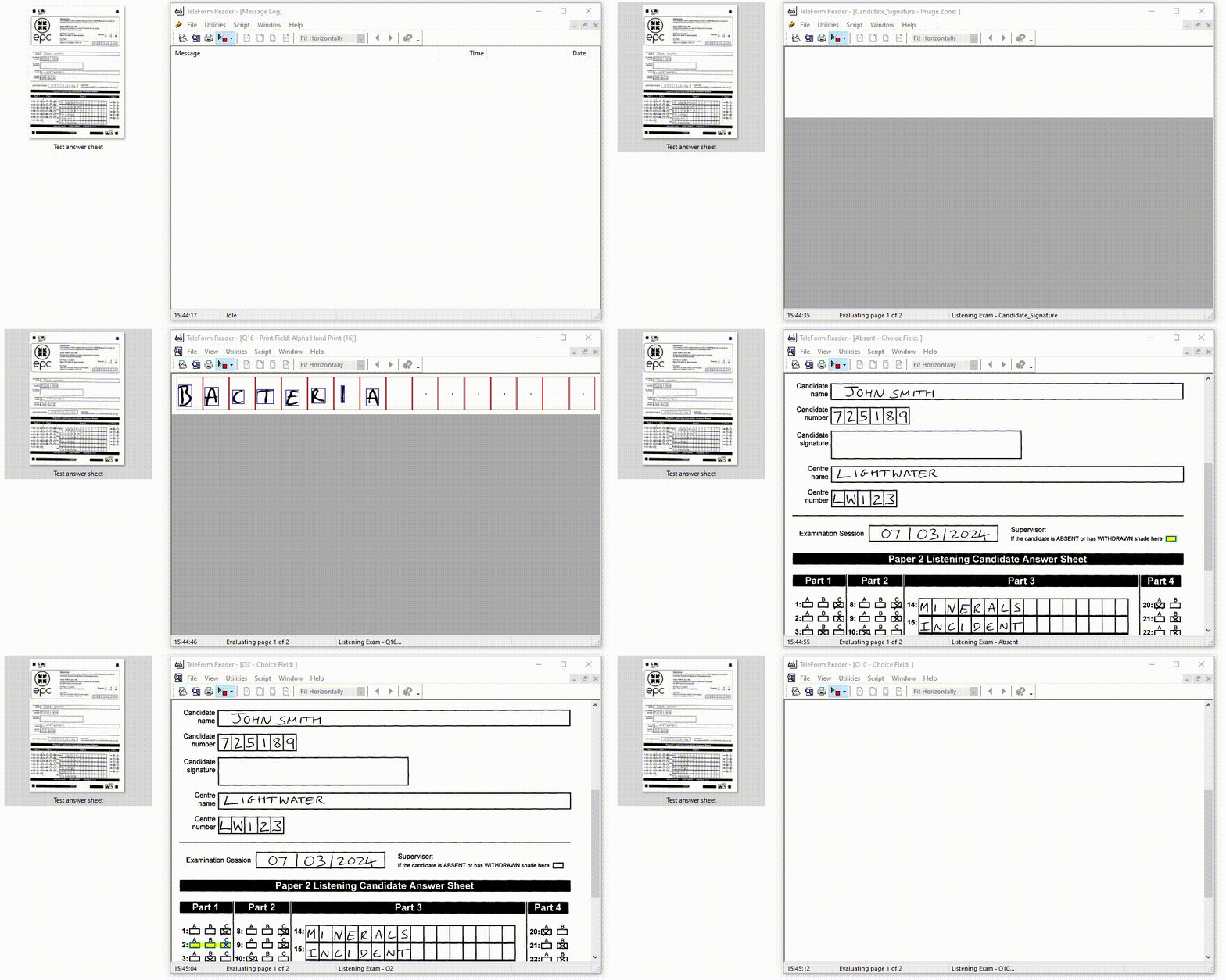
After document processing and classification, data capture software uses handprint (ICR), machine print (OCR) and checkbox (OMR) document recognition technology to automatically extract data from scanned documents. This will include constrained print fields, tick boxes, variable scales, comments, tick boxes and signatures.

To read short hand-print written responses from constrained print fields (one character per box) such as names, dates and numbers.

OMR technology identifies if a checkbox has been filled, with automatically handling of crossed out and amended responses.

To capture machine printed text.

Predictive key-from-image, coding and image snippet capture can be used to capture drawings or cursive handwriting.

To recognise all standard barcode types, including 2D matrix barcodes.

To confirm if a paper form has been authorised with a signature by calculating the fill percentage of the field.
Simple rules such as alpha, numeric, dictionaries, date ranges, look-ups and mandatory fields will be checked at this stage with any unrecognised fields/characters queued for human review.
These common-sense logic rules are applied to the extracted data to ensure that invalid responses are not exported (e.g. impossible to tick more than one response for a single-choice question). In such situations, the exception will be intelligently routed to the right human operators to review and correct. The entire process takes seconds meaning thousands of forms can be processed each day.
Case studies

Following an OJEU tender process, the British Council commissioned Civica as the prime contractor to deliver an on-screen marking (OSM) solution to mark up to 5 million ‘pen and paper’ IELTS tests each year.
As part of the agreement, Civica appointed ePC as its sub-contractor for the script capture, processing and verification work.

NEXT Distribution automated the weekly processing of its productivity bonus scheme timesheets for 4,500 employees across six UK distribution centres. The TeleForm-based solution two days of processing time every week – approximately 750 hours a year.

Cambridge English automated paper-based assessments with an exam processing and on-screen marking system, supporting the processing of millions of assessments each year.

Racing to School reduced manual administration by 75% by automating the collection and processing of post-event surveys using TeleForm.
Related products
ePartner Consulting combines decades of technical expertise with proven technology to deliver practical, scalable solutions tailored to the way your organisation works.

TeleForm automatically captures and indexes data and images from any form type, using handprint (ICR), machine print (OCR) and checkbox (OMR) recognition technology, ready for export to a database.

ABBYY FlexiCapture is a powerful data capture solution for extracting information from structured, semi-structured and unstructured documents for export into backend applications and archiving.