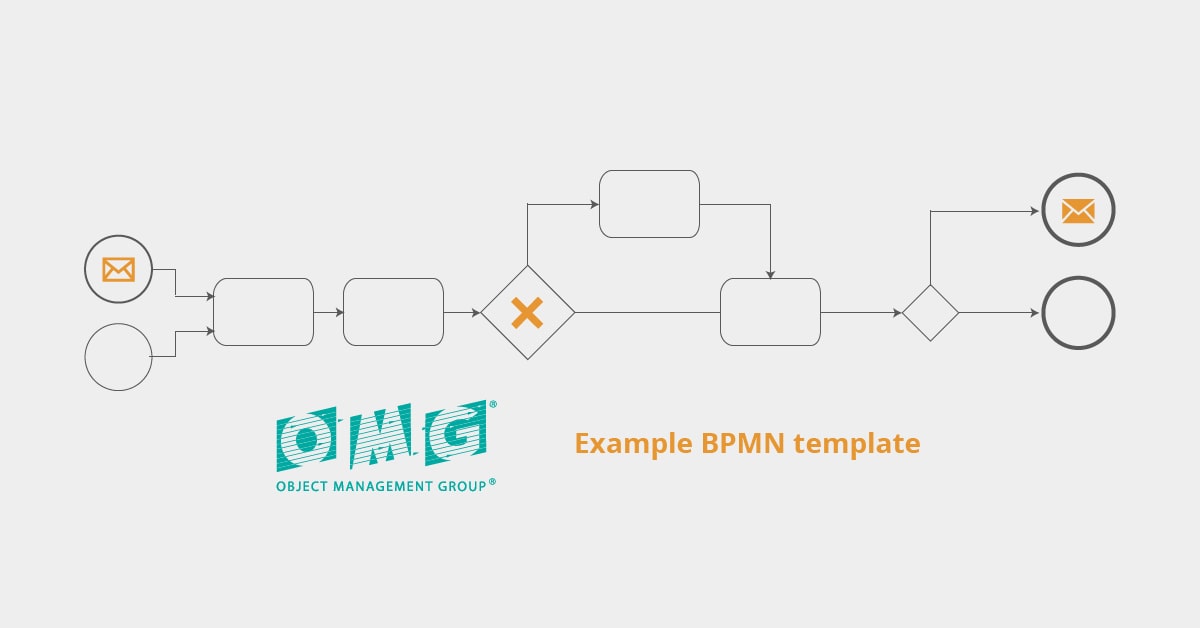
Business Process Model and Notation (BPMN) is a graphical representation for specifying business processes in a Business Process Diagram (BPD).
Who created BPMN?
Originally developed by The Business Process Management Initiative (BPMI), it has been maintained by the Object Management Group since 2005.
How BPMN works?
The BPMN language is based on flowcharts and graphical notations. The notations consist of four basic categories:


Each of the four categories contains a variety of objects that combine to create a BPD.
Why is BPMN important?
BPMN is important as it provides a standard notation readily understandable by all business stakeholders. These include the business analysts who create and refine the processes, the technical developers responsible for implementing them, and the business managers who monitor and manage them.
Consequently, BPMN serves as a common language, bridging the communication gap that frequently occurs between business process design and implementation.
How to achieve the BPMN certification?
If you want to learn the BPMN methodology, a good starting point is the OCEB™ 2 exam. It is run by OMG, the company that maintains the BPMN methodology. Unsurprisingly, the certifications focus on their specifications e.g. BPMN 2, BMM, BPMN and DMN.
Find out more on their website.
Udemy, a global marketplace for teaching and learning, offer courses on BPM and BPMN including BPMN for Business Analysts.
Should my BPM platform support BPMN?
BPMN was designed for predictable, sequential business processes, represented by rigid steps in a flowchart.
While it is great for modelling theoretical processes, which is always the first step to BPM implementation, it really is not capable of capturing the detail needed to configure typical workflows.
Here are some examples of the decisions a practical workflow implementation needs to include that BPMN simply does not have the language to describe.
- Does one user need to approve, all or a percentage?
- Can another step run in parallel to save time?
- Does it need assigning to a person, a role, a department, a group or could it be user or logic driven assignments?
- When is it due and what happens if it overruns?
- Should users be notified and by what method?
- Can the step be completed by eMail, without authentication, in bulk with other tasks or only individually?
- Can the task be delegated if needed?
Most BPM vendors have created great new ways of modelling processes, such as the Process Timeline™ technology in Process Director that represents workflows and processes as “what if” scenarios, which gives businesses the ability to anticipate the impact of hypothetical situations. These cannot be represented, or acted upon, through ‘typical’ BPMN flowcharts.
AI-driven, Process Timeline™ offers the earliest possible notification that some future task is predicted to be late. And it can do more than just notify you: this workflow engine can take direct action, escalating or re-routing activities to account for the predicted delay.
Conclusion
Is BPMN dead? Probably not. Is BPMN becoming less relevant? We think it is!
Process Director, and its business process modelling engine Process Timeline™, remains the ideal BPMN modelling alternative, offering:
- Continuous critical path analysis
- Predictive triggers
- Earliest possible notice of potential future delay
- High efficiency
- Intrinsic parallel behaviour
Simply list your tasks, and Process Timeline builds an easy-to-follow Gantt chart. You can add/modify activities, identify new dependencies, or change anticipated activity durations and Process Timeline automatically updates the chart to reflect the effect of those changes.
Seeking a fresh approach to business process modelling? Contact us to book your Process Director demo today or call us on 03300 100 000.